





Sterile oral electrolyte solution indicated for preventing or treating dehydration.
In 1950, a cholera epidemic was spreading through Mexico and Laboratorios PiSA responded with something that did not yet exist: the first bottled, ready-to-drink oral rehydration solution in the country (Abasto, 2025). What was born in a laboratory as a response to a public health crisis gradually transformed, over time, into one of the most recognized products in everyday Mexican life. Today, Electrolit is the leading brand in oral rehydration solutions in Mexico, second in hydrating and sports beverages in the country, and in the United States the fastest-growing brand in its category, with sales that surpassed 617 million dollars in the 52 weeks ending July 3, 2025 (BevNET, 2025), in a global market valued at 38.3 billion dollars with projected growth of 5.6% annually through 2034 (GM Insights, 2025). With that track record, Electrolit does not only need to be the most effective product. It needs to be present, with the same clarity as always, at every counter where someone makes a decision.
Hydration is not what it used to be. What once lived exclusively in pharmacies and in the bags of athletes now appears on the brunch table, on the work desk, and in the frequent traveler's carry-on. As Nate Rosen, a consumer packaged goods expert, puts it: "The category has benefited from changes in consumption patterns. It is no longer just about sports recovery — it is about maintaining daily wellness" (ABC17 News, 2025).
That shift opened new territory for Electrolit: cafes, hotels, gyms, restaurants, convenience points. Places where the shopper does not walk in looking for a rehydration solution but finds one in passing and decides in seconds whether to take it or not.
The problem is that those spaces were not designed for floor displays. Counters are small, communication materials rotate often, and there is no aisle where a floor structure can go. Electrolit needed something different: a piece that could live on any flat surface, that spoke clearly about what the product is, and that did so with the seriousness a brand with scientific backing deserves.
That was the conversation that gave rise to the Tent Card.
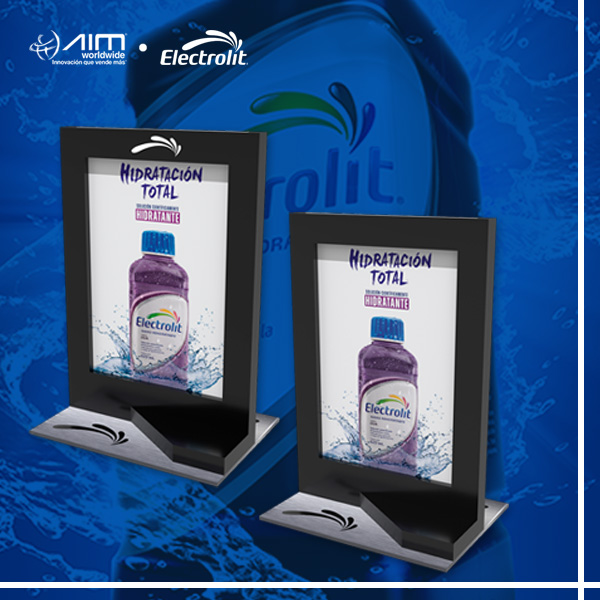
AIM designed, developed, and produced the Electrolit Tent Card: a countertop display built to last, to adapt, and to feel at home in any space where it is placed.
The base is MDF with a matte black satin finish and a composite aluminum panel with a black vinyl cut application. It is not the typical cardboard tent card that folds by the third day. It is a piece with weight, with presence, with the solidity of something that feels right before anyone reads a word. The matte black satin finish works as a perfect backdrop for Electrolit's visual identity, giving it a contrast that makes it stand out without effort.
On top of that base sits a frame in the same finish, with a slot at the top where a styrene graphic inserts. That detail changes everything. It means the same piece can communicate grape flavor this week, a new presentation next month, and a seasonal mechanic in December, all without replacing any part of the structure, without generating waste, without coordinating a new installation. The field rep removes the graphic, inserts the next one, and the counter stays active.
The final dimensions are 15 cm wide by 11 cm deep and 21 cm tall. The size of a large cup. But in that space fits Electrolit's entire value proposition: the scientific formula, the flavor, the total hydration message. 563 pieces were produced, chosen for the most strategic points of sale, not to be everywhere, but to be well-placed where it matters.
Placing the Tent Card at the selected points of sale produced something that rarely happens with conventional point-of-sale materials: results accumulated on their own, without adjustments, simply because the piece was in the right place.
The first change was one of presence. At pharmacy counters, cafe bars, and gym reception desks where there had been no Electrolit communication before, the tent card simply showed up. Not competing for space with anyone, not fighting for room in a crowded shelf. Just there, visible, constant, reminding the consumer that there is a hydration option worth considering. And because those are spaces the same people visit week after week, that presence kept building quietly but steadily.
The second change was one of timing. The moment the tent card speaks is the best possible moment: when the consumer has already stopped, is already still, is no longer in a rush. The person waiting at the pharmacy register, the one waiting for their order at the cafe, the one arriving at the gym reception to check in. Those seconds of waiting, which in other advertising formats are invisible, here become real attention time. The "Total Hydration" message arrives without interference, without visual competition, at the quietest moment of the purchase journey.
The third was one of brand perception. Something happens when a communication piece is well built: the consumer does not analyze it consciously, but they register it. The weight of the MDF, the satin finish, the aluminum frame, all of that communicates something about Electrolit before anyone reads a single word. It says this is a serious brand, one that takes care of details, one that did not arrive at this counter with whatever was available. In a category where new brands keep appearing, that perception of care and quality translates into preference.
The fourth was one of agility for the field team. For the rep visiting several points of sale a week, the interchangeable graphic system made a real difference in their daily operation. Updating the message on a conventional tent card means removing the piece, sourcing new material, coordinating someone for installation. Here, changing the graphic takes under a minute. That simplicity is not a small detail for a brand growing at the pace Electrolit is growing, with a 400-million-dollar investment in new plants in the United States to meet demand (KVIA, 2025), and that needs its point-of-sale presence to move at the same speed as its commercial strategy.
The fifth was one of real durability. The tent cards placed did not get removed when the first campaign ended. They stayed there, on the same counter, communicating different messages with each graphic change. That turned what could have been a campaign expense into an investment that paid off over time. A piece that stays, that does not deteriorate, that does not generate waste every time there is a new message. That is exactly what a brand with Electrolit's track record needs at its most important points of sale.
What This Tent Card Opens Up for Your Brand
There are conversations that large-format displays cannot have. The ones that happen 30 centimeters from the consumer, when they have already stopped, when they are still and available. Those conversations need a different piece, smaller, more precise, closer.
A well-made tent card is not a second-tier resource. It is the ideal format for the spaces where shoppers make decisions without realizing it: the counter, the register, the bar. And when that piece has the solidity of MDF, the elegance of aluminum, and the flexibility of an interchangeable graphic, it becomes something worth keeping always on, always updated, always speaking for the brand.
For wide portfolios, for brands that launch flavors regularly, for campaigns that change by season, the interchangeable graphic system solves one of the most common problems in point-of-sale materials: obsolescence. A tent card that can be updated in seconds does not go stale when the campaign changes. It evolves with it.
Does Your Brand Need a Communication Piece That Is Where Displays Cannot Reach?
At AIM, we design, develop, and produce point-of-sale materials for brands that understand that consumer attention is not always won in the aisle. Sometimes it is won at the counter, at the register, at the bar. Contact us at www.aimww.com and let's build together the piece your brand needs.
Know more about our pop material.