




Before shoppers pick up a product, compare it with alternatives, or decide to purchase it, there is a decisive moment: the instant something captures their attention. In a supermarket, where hundreds of products compete simultaneously, attracting that attention requires much more than appealing packaging or an attractive promotion.
POP elements (Point of Purchase) are communication and merchandising tools designed to strategically influence the shopper's journey. Each element serves a different purpose: some spark curiosity, while others guide consumers, simplify product selection, or communicate a purchasing opportunity.
However, their true potential emerges when they stop functioning as independent pieces and become part of an integrated shopper marketing campaign.
At AIM Worldwide, one of our greatest strengths is developing comprehensive and efficient point-of-sale campaigns, combining innovation, design, and functionality to attract shoppers and facilitate their interaction with products.
POP elements are physical, graphic, or technological resources that complement product presentation within a retail environment. Their purpose is to improve communication between brands and shoppers where purchasing decisions take place.
Unlike other advertising media, POP materials have the advantage of reaching shoppers when products are within their immediate reach. This creates an opportunity to connect commercial messages with purchasing actions.
From a small shelf strip to a fully customized endcap cover, each solution addresses a specific need within the merchandising strategy.
Understanding how each element works allows brands to develop more efficient campaigns, make better use of retail space, and avoid visual clutter. Not every POP element needs to sell directly; some prepare the way for others to do so.
Shoppers walking through a supermarket do not necessarily notice every product around them. Their attention tends to focus on what they are looking for or on visual stimuli that stand out from their surroundings.
Shelf stoppers are graphic elements that extend perpendicularly from the shelf into the aisle, creating a visual focal point that differentiates a product or brand from the surrounding merchandise.
What do they contribute to a POP campaign?
Their design should prioritize clarity, contrast, and readability from different viewing angles.
What happens when a bottle, package, or brand character takes on dimensions that are difficult to overlook?
Standees are freestanding advertising structures that represent products, characters, or creative concepts on a larger scale. They can be manufactured using cardboard, plastic, and other materials, depending on campaign requirements.
Their main appeal lies in their creative flexibility. They are particularly useful for product launches, seasonal campaigns, and retail activations designed to spark curiosity before shoppers reach the shelf.
Unlike conventional POP displays, their primary function is not necessarily to hold merchandise but to create a visual connection between shoppers and the brand.
Endcaps offer an opportunity to create differentiated spaces within supermarkets without completely replacing existing retail fixtures.
Endcap covers are customized structures and graphic elements that transform these areas into dedicated commercial communication spaces.
Their design can incorporate side panels, headers, shelf strips, and lower graphic panels under a unified creative concept.
Their strategic value lies in transforming a conventional retail fixture into a dedicated communication space, while maintaining product capacity and facilitating product identification.
They are particularly useful for campaigns that promote multiple product variations or build a creative concept around a specific shopping season.
A POP display may feature an excellent product arrangement, but it still needs an element that allows shoppers to quickly identify what it offers and why it deserves their attention.
A header is a graphic or structural component positioned at the top of POP displays, endcaps, or retail shelving. It serves as the primary visual headline of the exhibition.
It can communicate a promotion, introduce a product launch, highlight a benefit, or simply facilitate category identification.
Interchangeable headers also offer an interesting solution for long-term campaigns, allowing brands to update their communication without replacing the entire POP display structure.
In this way, design addresses not only advertising needs but also operational efficiency and material optimization.
Advertising totems are independent vertical structures that communicate commercial messages without relying directly on existing shelving. Their format makes them suitable for store entrances, circulation areas, and locations with limited floor space.
When shelves or trays are incorporated, as illustrated by the Bokados POP display featured in the accompanying image, the result is a solution that combines the vertical presence of an advertising totem with the functionality of a product POP display.
This combination integrates communication, product capacity, and accessibility within a single structure.
Its primary advantage is the ability to maximize available vertical space, creating additional merchandising opportunities without occupying large floor areas.
Not every POP material needs to be large to fulfill a strategic purpose.
Shelf strips are graphic elements placed along the front edges of retail shelves. They help identify products, define branded spaces, and communicate relevant information precisely where shoppers compare alternatives.
A well-designed shelf strip can facilitate the identification of flavors, product variations, promotions, or product families.
When consistently applied across multiple shelf levels, shelf strips also contribute to visual continuity and a more organized product presentation.
Their compact dimensions and ease of replacement make them a practical solution for both temporary and permanent POP campaigns.
Every POP material should serve a commercial objective. Before selecting a solution, brands must identify what they want to achieve within the retail environment.
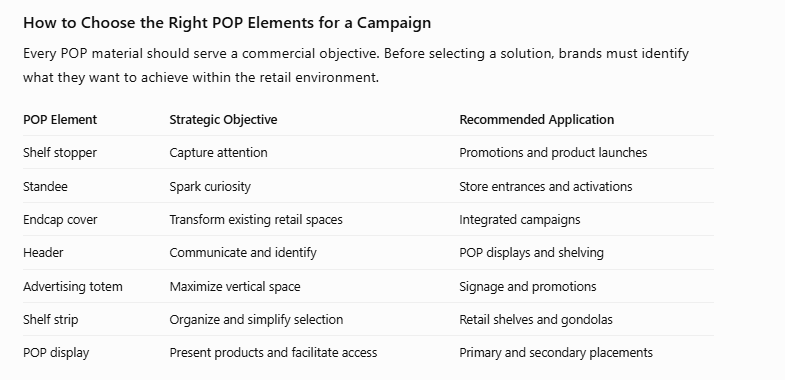
The selection process should also consider store format, available dimensions, budget, campaign duration, and product replenishment requirements.
Imagine the launch of a new snack product line. A standee positioned at the supermarket entrance sparks shopper curiosity. Further along the shopping journey, a shelf stopper identifies the product's location, while a customized endcap presents the different varieties. Headers communicate the launch, and shelf strips help shoppers identify each product variation.
Every element fulfills a specific function, yet they all work toward the same objective.
This coordination is what differentiates an integrated POP campaign from a simple collection of advertising materials.
When POP elements share a consistent visual identity, strategic placement, and commercial message, they can create a more cohesive shopping experience. Shoppers no longer need to interpret disconnected messages; instead, they encounter a sequence of communication that accompanies them throughout their journey.
At AIM, we understand that every brand, product, and retail channel presents different challenges. That is why our approach goes beyond the design and manufacturing of POP displays.
One of our greatest strengths is our ability to develop comprehensive and efficient campaigns that attract shoppers through innovation, selecting and combining different POP elements according to the objectives of each project.
We integrate solutions such as metal, modular, cardboard, MDF, refrigerated, hybrid, and experiential POP displays, along with customized graphic materials that complement commercial communication (AIM Worldwide, n.d.).
Our approach ensures that every component serves a specific purpose: maximizing retail space, simplifying replenishment, improving product accessibility, communicating benefits, or creating new ways for shoppers to interact with products.
Innovation does not necessarily mean incorporating complex technology. Sometimes, innovation involves finding a simpler way to present a product, update a promotion, or develop a structure that can be reused across multiple campaigns.
The real value lies in finding the right solution for each challenge.
The future of point-of-sale advertising is not about filling supermarkets with more visual stimuli. It is about designing stimuli that serve a meaningful purpose.
Shelf stoppers, standees, endcap covers, headers, advertising totems, shelf strips, and POP displays represent different opportunities to connect with shoppers. Their effectiveness depends on design, placement, functionality, and coordination between all elements.
At AIM Worldwide, we develop solutions that transform retail spaces into innovative, functional, and results-oriented shopping experiences.
Because a great POP campaign is not measured by the number of elements it uses, but by what it achieves when every element works together.
Know more about our pop displays.