



Producer and distributor of soft drinks with presence in 180 countries around the world.
There are objects people do not know they need until they hold them in their hands. The chili strainer is not necessarily a product the Mexican consumer sets out to find. But place it in the right context — connected to everyday cooking and offered alongside a familiar purchase — and a simple household object can become something more valuable: a promotional article designed to remain useful long after the promotion ends.
That was the opportunity behind the Betterware Chili Strainer developed for a Coca-Cola promotional initiative.
Betterware has operated in Mexico since 1995 and became a fully Mexican company in 2001. Today, the company defines its vision as bringing harmony to Mexican homes through innovative solutions for different areas of the household (Betterware, 2026).
Coca-Cola, meanwhile, has developed En Tu Hogar by Coca-Cola, a direct-to-consumer platform through which consumers can purchase products from the Coca-Cola portfolio for home delivery. Coca-Cola's own promotional terms confirm that the platform has been used for purchase-based promotions delivered directly to consumers' homes (The Coca-Cola Company, 2025).
The combination created an interesting opportunity: take a practical household product and transform it into a promotional object capable of connecting the beverage purchase with another important consumption space — the Mexican kitchen.
Promotional articles face a simple but important challenge: they need to be useful enough to survive beyond the campaign.
A giveaway may attract attention for a moment. A useful object can remain in the consumer's environment for months or even years.
For this project, the challenge was therefore not simply to manufacture another promotional giveaway. The objective was to create an article with three important characteristics: relevance to everyday life in the Mexican home, the recognizable functionality associated with a household-products brand such as Betterware, and the ability to be manufactured at the scale required by a major promotional activation.
The selected context was particularly relevant because En Tu Hogar by Coca-Cola operates as a direct-to-consumer purchasing platform. Official Coca-Cola promotional terms show that purchases made through the platform can be delivered directly to consumers' residential addresses, creating a promotional environment in which the purchase and the incentive can form part of the same home-delivery experience (The Coca-Cola Company, 2025).
The kitchen became the natural territory for the promotional article.
Betterware has built its product proposition around practical solutions for different areas of the home, supported by catalogs, digital stores and a nationwide direct-selling structure (Betterware, 2026).
Instead of creating an object whose usefulness depended on the campaign itself, the project focused on something that could continue performing a function after the promotion was over.
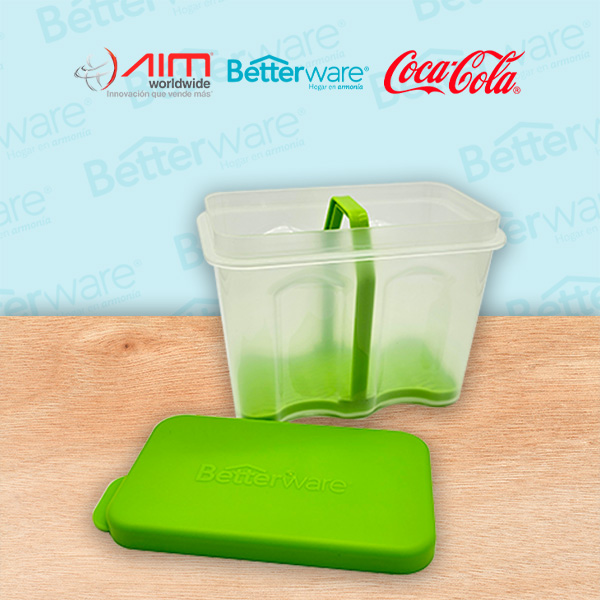
AIM designed, developed, and produced the Betterware PRO Chili Strainer as a promotional article for Coca-Cola, adapting the concept to the production, packaging, and logistics requirements of a large-scale campaign distributed through the En Tu Hogar route.
The strainer was manufactured in BPA-free plastic, with a capacity of 1.3 liters and dimensions of 16.5 × 8.5 × 13 cm.
Its compact format allows it to fit naturally into the refrigerator or kitchen environment without occupying unnecessary space.
The design combines an exterior container with an integrated draining basket, allowing consumers to remove chiles, jalapeños, olives, or other preserved foods while separating them from the liquid in which they are stored.
A removable inner basket with an integrated handle simplifies serving, while the lid allows the container to return directly to refrigeration after use.
It is a relatively simple object.
And that simplicity is precisely its strength.
Instead of requiring the consumer to learn how to use a promotional product, the article fits into an existing behavior inside the kitchen.
For the campaign, the logistics were designed around high-volume production. Packaging was configured in boxes measuring 51 × 36 × 53.5 cm containing 40 pieces each, without printing on the secondary packaging.
Production capacity was structured across AIM's manufacturing operations in Guadalajara, Colima, and Ciudad Guzmán, with production ranges between 10,000 and 40,000 pieces depending on campaign requirements.
This manufacturing structure allowed the promotional article to move from product concept to a format capable of supporting a large-scale consumer activation.
The most important outcome of this project is not a sales percentage or an engagement figure that cannot be independently verified.
It is the relationship between utility, distribution, and brand presence.
By connecting a household product with a home-delivery purchase, the activation reduced one of the traditional barriers associated with promotional merchandise: redemption friction.
Coca-Cola's own terms for En Tu Hogar promotions demonstrate that the platform supports promotional mechanics connected directly to online purchases and residential delivery (The Coca-Cola Company, 2025). In this type of model, the promotional experience can happen within the same purchasing journey instead of requiring a separate visit to another location.
The second advantage was recognizable product context.
Betterware is not simply a name printed on a promotional object. Its business is built around products designed for everyday use throughout the home. The company describes its vision around innovative household solutions and operates through a large network of Associates and Distributors (Betterware, 2026).
Public corporate reporting also demonstrates the scale of that network. In the first quarter of 2024, Betterware's parent company reported an average base of approximately 1.21 million Associates and Consultants and 63,541 Distributors and Leaders across its operations (Betterware de México, 2024).
That existing association with household products gives a promotional collaboration a different starting point: the article belongs naturally to the category in which Betterware already operates.
The third advantage is potential longevity.
Advertising disappears when the campaign ends.
A useful kitchen object does not necessarily disappear with it.
Every time the consumer opens the refrigerator, prepares food, drains jalapeños, or places the container back on the shelf, the promotional article has another opportunity to become part of the household routine.
That does not allow us to claim a specific increase in sales or brand recall without campaign measurement data.
But it does illustrate one of the fundamental advantages of functional promotional merchandise: the physical object can remain in the consumer's environment after the media investment has ended.
Finally, the project demonstrated AIM's ability to translate a promotional concept into industrial-scale production.
With production ranges from 10,000 to 40,000 pieces and manufacturing capabilities distributed across multiple locations, the challenge was not only designing an attractive product. It was creating a production system capable of delivering it consistently at promotional scale.
The Betterware × Coca-Cola × AIM project illustrates a promotional model built around three elements:
a high-reach consumer brand, a company associated with practical household products, and a direct-to-consumer channel capable of bringing the experience into the home.
That combination matters.
A promotional article should not exist simply because a campaign needs a giveaway.
It should make sense in the consumer's life.
Betterware's own history reflects a business model centered on practical household solutions. The company has operated in Mexico since 1995 and has progressively expanded its direct-selling and digital capabilities, reaching one million Associates in 2020 and continuing to develop digital tools for its sales network (Betterware, 2026).
En Tu Hogar adds another element to that equation: distribution.
Coca-Cola has demonstrated through the platform that promotions can be connected directly to digital purchases and delivered to consumers' homes (The Coca-Cola Company, 2025).
And AIM adds the third component: turning the idea into a physical product capable of being manufactured at scale.
The result is a different way of thinking about promotional merchandise.
Not:
What can we give away?
But:
What can we put in someone's home that they will still want to use after the campaign is gone?
At AIM, we design, develop, and produce promotional articles for brands looking to extend their presence beyond traditional advertising and into consumers' everyday lives.
From concept and product development to large-scale manufacturing and logistics, we create promotional pieces designed not simply to be delivered — but to be used.
Contact us and let's build the promotional article your next campaign deserves.
Know more about our promotional products.


.png)